


The U.S. residential brokerage industry has always been fragmented, with more than 1.4 million Realtors spread across thousands of firms. That fragmentation has long served as both a strength and a weakness. It allowed innovation and competition to flourish, but it also left the industry vulnerable to rapid shifts when one player finds a way to aggregate scale.
The announcement that Compass will acquire Anywhere Real Estate marks the single largest consolidation in US brokerage history. Compass is citing a combined total of 340,000 agents across 120 countries, but the U.S. footprint tells a different story: about 219,000 agents nationally, or roughly 15 percent of the Realtor population.
The difference between those two figures matters. The 340,000 number makes headlines and highlights Compass’s new global reach, but it overstates the effect on U.S. competition. The number that matters for domestic market structure is 219,000. That is where the implications for MLSs, regulators, and consumer search will play out.
The Agent Numbers Behind the Deal
Compass has about 40,000 U.S. agents. Anywhere brings roughly 179,000, including 52,900 in its company-owned brokerage and about 126,000 in its U.S. franchise brands. Together they account for 219,000 agents in the United States. Measured against the National Association of Realtors’ membership base of 1.45 million, that gives Compass an umbrella reach of 15 percent. On a company-owned basis alone, Compass plus Anywhere Advisors will directly operate about 92,900 agents, or 6.4 percent of the total.
The global number that Compass is citing comes from Anywhere’s international presence. Century 21, Sotheby’s International Realty, Better Homes and Gardens, and other brands operate in more than 100 countries outside the United States. When those agents are added, the combined total rises to 340,000. It is an impressive figure but less relevant to questions of U.S. market power.
Placed in context, the other top brokerages are smaller by headcount. eXp Realty reports about 82,700 U.S. agents. Real Brokerage has grown rapidly to nearly 29,000. HomeServices of America operates 37,700. Together the top ten brokerages by sides (2024) now account for an estimated 34 percent of all agents, leaving approximately two thirds spread across independents and regionals. The industry is consolidating, but it is far from consolidated.
US Agent Count Distribution (for Real Trends’ 2024 Top Brokerage by Side)
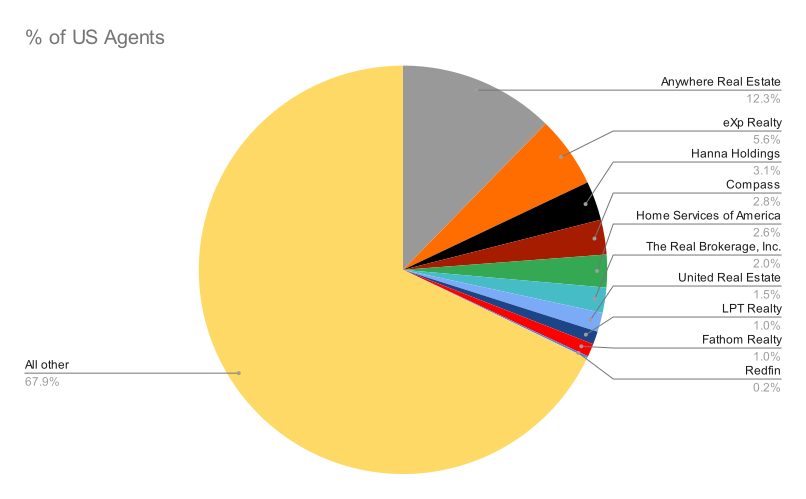
Data from various sources listed at bottom of article and top 10 list from Real Trends 2024 Top 1,000
The Regulatory Question
Antitrust regulators will not measure this deal by counting heads alone. On a national basis the industry remains unconcentrated, with even the largest brokerages combined holding less than a quarter of sales. However, the Justice Department and the Federal Trade Commission will look closely at local markets where Compass and Anywhere Advisors both operate. In certain metro areas, a merger of company-owned offices could create strong positions that warrant review.
Total Sides & Estimated Transactions for 2024 US Real Estate Market
| RT Ranking | Company | Sides | Transactions | % of Total Transactions |
| 1 | eXp Realty | 350,119 | 250,085 | 6.16% |
| 2 | Anywhere Advisors | 246,728 | 176,234 | 4.34% |
| 3 | Compass* | 228,785 | 163,418 | 4.03% |
| 4 | HomeServices of America | 224,485 | 160,346 | 3.95% |
| 5 | Hanna Holdings | 92,154 | 65,824 | 1.62% |
| 6 | The Real Brokerage, Inc. | 90,298 | 64,499 | 1.59% |
| 7 | Redfin | 46,421 | 33,158 | 0.82% |
| 8 | United Real Estate | 46,025 | 32,875 | 0.81% |
| 9 | Fathom Realty | 36,800 | 26,286 | 0.65% |
| 10 | LPT Realty | 36,369 | 25,978 | 0.64% |
| Top 10 TOTAL | 1,398,184 | 998,703 | 24.60% | |
| Everyone Else TOTAL | 3,061,297 | 75.40% | ||
| Assumptions | ||||
| Est. Sides > Transactions | 1.4 | |||
| Total US transactions | 4,060,000 |
Data based on RealTrends 2024 Top 1000, reported 2024 US transaction volume and sides to transaction translation assumption.
The more important regulatory question is not how many agents work under the same parent company, but how inventory and consumer access are managed. Compass is already locked in a lawsuit with Zillow over listing-display rules. With Anywhere’s brands under its umbrella, Compass will control just under 10% of all transactions and an enormous potential referral network. Regulators are likely to approve the deal but may impose behavioral remedies or conditions designed to protect fair access.
Future Scenarios
While still very early in this developing story, there are a few scenarios that have been gaining steam as the market evolves.
The Big Tent
One scenario is the “Big Tent.” Compass maintains the independence of Anywhere’s legacy brands while integrating back-office technology, relocation, and referral systems. The financial gains come from efficiency rather than from forcing brand unification. This is the dream Anywhere likely has been chasing and, with the Compass shift, could finally unlock this. Mid-sized regionals will feel pressure to either partner or sell, while Compass’s scale improves its cost structure.
Inventory Gravity
Another scenario is “Inventory Gravity.” Here Compass leverages its size to promote in-network exclusives and early access to listings. Even if the MLS remains the official source of record, consumers who want the first look may have to enter Compass’s ecosystem. That would shift leverage dramatically toward the largest firms and away from independents. This strategy carries the most regulatory risk as it grows and would not happen overnight.
Barbell Market
The third scenario is the “Barbell Market.” On one side, low-cost, cloud-based brokerages such as eXp and Real continue to attract agents who value maximum splits and independence. On the other side, Compass offers full-service brands with relocation, referrals, and marketing support. The middle ground shrinks. Traditional regionals without scale in either direction will struggle to compete. You can see how based on average price per side, the market could start to segment itself into two groups (assuming consumer needs will be aligned this way):
“Barbell” Scenario Based on Price Per Side
| RT Ranking | Company | Volume ($) | % of total | Price Per Side | Player |
| 1 | Compass* | 231,040,000,000 | 14% | $1,009,856 | Tier 1 |
| 2 | Anywhere Advisors | 183,810,000,000 | 11% | $744,990 | Tier 1 |
| 4 | HomeServices of America | 136,640,000,000 | 8% | $608,682 | Tier 1 |
| 6 | Douglas Elliman | 36,390,000,000 | 2% | $1,670,876 | Tier 1 |
| Tier 1 Volume | $587,880,000,000 | 36% | |||
| 3 | eXp Realty | 152,660,000,000 | 9% | $436,023 | Tier 2 |
| 5 | The Real Brokerage, Inc. | 42,440,000,000 | 3% | $469,999 | Tier 2 |
| 7 | Hanna Holdings | 33,740,000,000 | 2% | $366,126 | Tier 2 |
| 10 | United Real Estate | 20,450,000,000 | 1% | $444,324 | Tier 2 |
| Tier 2 Volume | $249,290,000,000 | 15% | |||
| 8 | Redfin | 29,480,000,000 | 2% | $635,057 | Outlier |
| 9 | Side | 23,870,000,000 | 1% | $1,013,459 | Outlier |
Data based on RealTrends 2024 Top 1000
The Future of the MLS
The MLS is not going to disappear overnight. It remains the compliance and cooperation backbone for residential real estate. Yet, if more listings debut as “coming soon” inside brokerage networks before hitting the MLS, the value of MLS data to buyers could erode. Expect MLSs to consolidate further, tighten their rules on pre-market listings, and forge new partnerships with portals to reinforce their relevance. The MLS of the future will be smaller in number, larger in footprint, and more focused on protecting broad consumer access.
What to Watch
For agents, the most pressing question will be whether Compass unifies commission splits across its brands or allows franchises to set their own terms. For consumers, the key issue is how quickly listings appear on public portals compared to in-network channels. For regulators, the central focus will be whether the merger changes the competitive dynamics of access to inventory.
Portals are a whole other piece to this puzzle. They remain the main consumer gateways, and they will resist any move that weakens their role in discovery. Expect further legal battles and policy debates about how and when listings are displayed.
A Turning Point
This merger is not the end of competition in real estate. It does not eliminate the MLS, nor does it create a monopoly. But it signals a turning point. With 219,000 U.S. agents under one roof, Compass has established itself as the dominant full-service platform. Add in the 340,000 global figure and the scope becomes clear: Compass is now both the largest U.S. brokerage and a global brand network of unprecedented reach. The open question is how independents, teams, and consumers will adapt in the space between.
Sources
- HousingWire: Compass buys Anywhere Real Estate for a combined 340,000 agents across 120 countries (Sept 2025)
- Anywhere Real Estate Annual Report: U.S. agent count and franchise data
- National Association of Realtors: Membership statistics, May 2025
- eXp Realty Q2 2025 results, total agent count
- Real Brokerage August 2025 update, agent growth (estimates 10% Canadian, 90% US)
- HomeServices of America agent count
- Wall Street Journal: Compass to acquire Anywhere Real Estate, creating largest U.S. brokerage (Sept 2025)
- Redfin Agent Count
- United Real Real Estate Agent Count
- Fathom Agent Count
- LPT Agent Count